
A Barrel Stave as an integral Loom
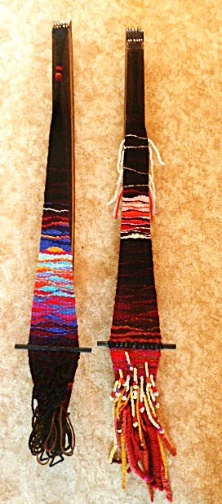
For many years I have been interested in integral looms. I have made use of a variety of found structures to support and enhance the creation of woven and constructed textiles. These have included roof slates and stones, wooden branches, and detritus from the beach. Such items often have a patina, a wood grain structure and all bear the evidence of a previous life, remnants of cut marks, paint and varnish and ingrained dirt.
Whatever I find or collect I am careful not to remove these signs completely, preferring a light brushing or careful use of steel wool. It was from a beach on the North East coast that during the 1970’s I first came across three time and tide washed oak barrel staves. There was no sign of rot or worm and these offered me the opportunity to use them as a structure to hold and support a warp. Barrel Staves are easily obtained through eBay…no need to explore the local beaches!
Brushing with a stiff brush helped to remove any ingrained sand or dirt, then I started by a washing them in soapy water and rigorous rinsing to remove the effects of being in salt water for some time. The dark brown of the stave just needed waxing to aid the surface structure and consolidate a relative uniform colour. This is the same process I use today to create a loom structure.
Read More About A Barrel Stave as an integral Loom
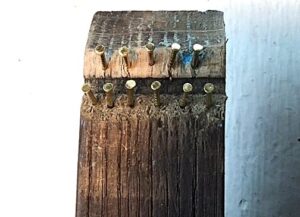
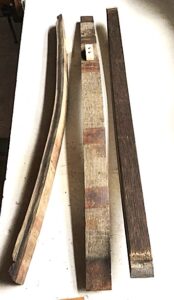
View of Brass pins at top, similar the bottom. Side views and Back view of Stave
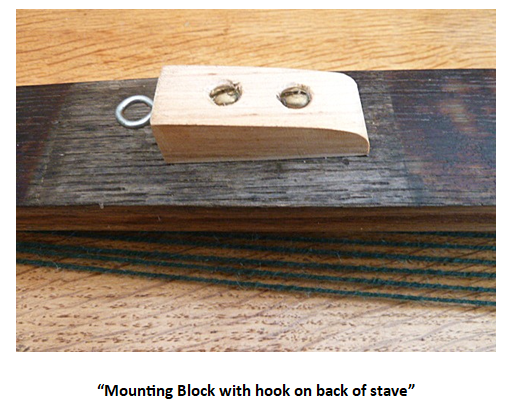
The concave shape of a barrel stave with tapering sides is particularly suited for use as a loom. When warped it has an affinity with the sounds of a musical instrument. Before proceeding I need to consider a theme or concept. Having a distinctive shape, a vertical idea and a landscape or similar form might be suitable. From a primary experience, photograph, sketch or painting I conclude the colour necessary for the warp. This will be visible at the top and bottom and might also be seen within the woven element. At this stage thought must be given to how it will be hung and how to attach on the back a hook or similar. Below is the specific image of a mounted block with hook, but a single large hook positioned carefully will suffice. Care must be taken if the stave is to hang parallel to the wall.
Next and the method of attaching the warp. I use one inch brass panel pins, spaced alternately, at the extreme top and bottom of the stave. Two lines will allow for more pins and I use five for the top line and six on the second. This is the maximum for the width of this stave, approx. 1 ½ inches (4 cm), a wider stave can accommodate more. This also depends on the thickness of the warp yarn. Having two lines makes it easier to warp and if there was just a single line there is every likelihood that the wood would split. Insert the brass pins with a slightly backward lean which will help to keep the warps in place. With the top and bottom pins attached next is to consider how to warp and stretch the width of the warp.
Secure one end of the warp yarn to the first pin and go down to the first pin at the other end and around this before returning to the top. Around the next pin and repeat until the requisite number of warp threads has been achieved before tying off. Take care to maintain an even tension. With this continuous warping technique, it is possible to adjust the warp tension across the width.
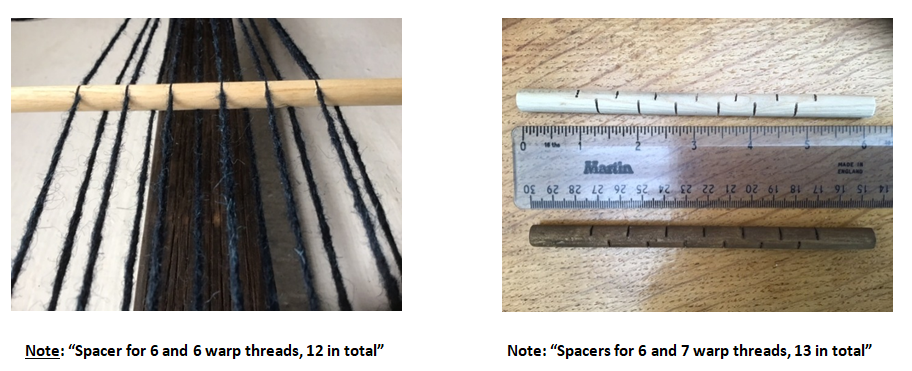
The spacer is used to give width to the warp and can be placed higher or lower on the warp as needed. I use 1 cm or 3/8th of inch dowel which can be stained as required. Marks are made from the centre at about 1 ½ cm or 5/8th of an inch. Working from the top and alternately beneath as in the above image the marks coincide with the exact number of warp threads. Then a saw is used to cut a groove approximately half way across the dowel. This can then be inserted between the warps alternatively top and bottom. Make sure the warps are held in the cut grooves and avoid twisting of the warps.
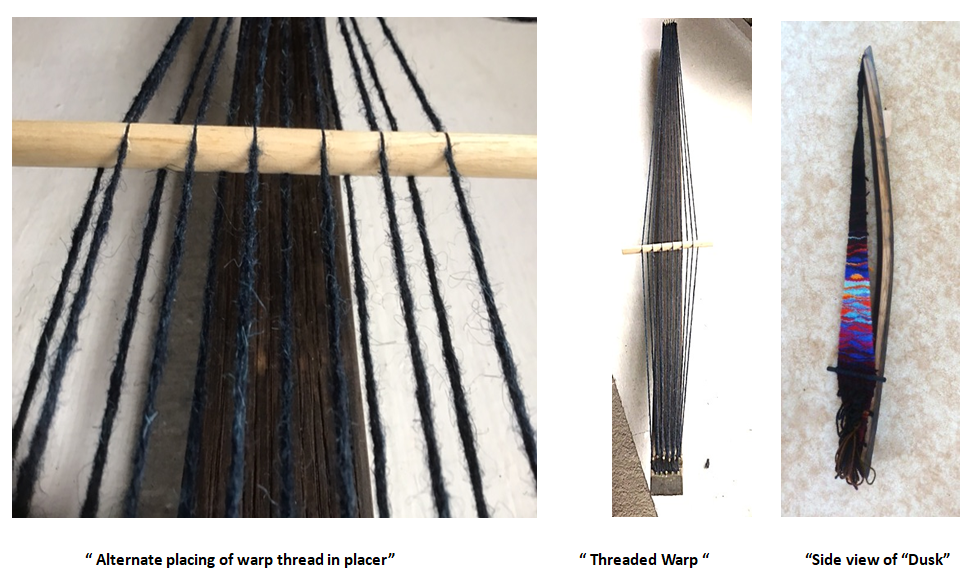
Having decided the position of the spacer I wrap a cord around the spacer and the warps to secure it in position.

Thought must be given to a suitable theme and the subsequent selection of a colour palette. I incorporate many aspects of weaving from weft faced fabrics, single strand, or plied yarns, plaited, and knotted, tufting and Sumak. Always be aware that the weaving is tapered and care must be taken on creating a suitable selvedge.
Explore the myriad of possibilities and enjoy!
Michael Crompton Winter 2025-2026
www.michael-crompton.co.uk